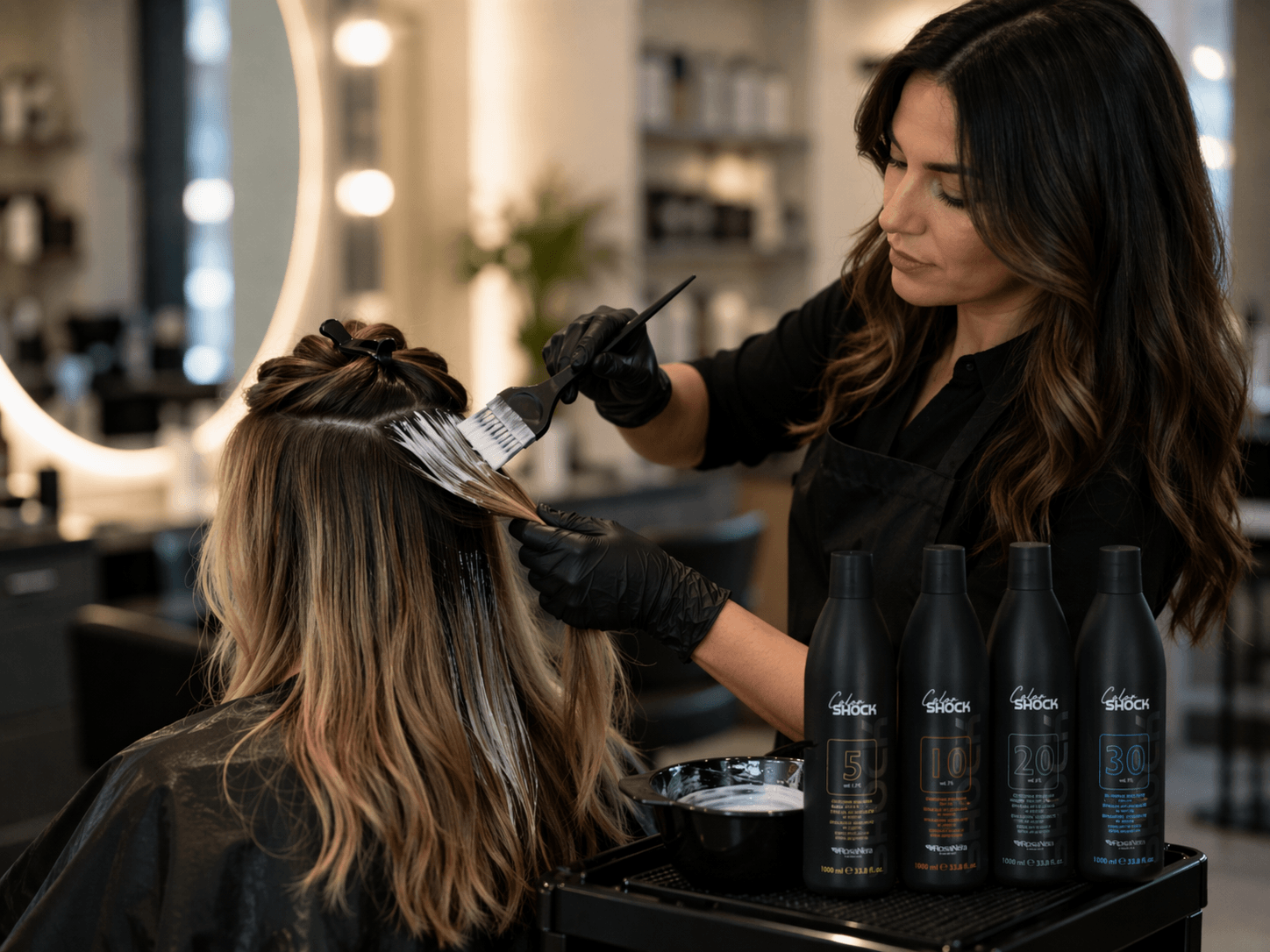
The strength of the oxidant has a direct impact on the coloring result. It determines whether the color will simply deposit tone or also lift and lighten the hair. Choosing the wrong oxidant can lead to uneven color, increased dryness, and a result that does not meet either the stylist’s or the client’s expectations.
In this article, we will explain when to use 1.5%, 3%, 6%, and 9% oxidant, what each strength is designed for, and how to select the right one based on the condition of the hair and the desired final result.
| Desired result | Oxidant | Processing time |
|---|---|---|
| Toning, refreshing colour without lift | 1.5% (5 vol.) | 30–35 min |
| Tone-on-tone, darkening, first greys | 3% (10 vol.) | 30–35 min |
| Standard colouring, full grey coverage, +1–2 levels | 6% (20 vol.) | 30–35 min |
| Lifting 2–3 levels with dye | 9% (30 vol.) | 30–35 min |
| Bleaching up to 10 levels with powder | Powder + 3%, 6% or 9% | 20–45 min (monitored) |
Processing times refer to Color SHOCK dyes (1:2 mixing ratio). For bleaching powder the time depends on the technique and the base — visual monitoring is essential throughout the process.
1.5% oxidant is one of the gentlest strengths. It is commonly used for toning, color correction, and refreshing the tone when no additional lifting effect is needed.
This strength is suitable when you want to:
If the goal is not to lighten the hair, but simply to adjust or tone the color, 1.5% oxidant is often the most suitable choice.
3% oxidant is suitable when a gentle approach is still important, but a more visible color result is needed than with toning alone.
It is most often used when the goal is to:
3% oxidant is a good option when color richness matters, but you still want to minimize the impact on the natural hair structure.
6% oxidant is one of the most commonly used strengths in professional salon work. It is considered the most versatile option because it works well for standard coloring, gray coverage, and light lifting.
6% oxidant is most often used when you want to:
It offers a strong balance between performance and controlled impact on the hair.
9% oxidant is used when a stronger lifting effect is needed. It is typically chosen when the goal is to lighten the hair by several levels or to perform more intensive coloring techniques.
9% oxidant may be the right choice when you want to:
However, the stronger the oxidant, the more important it is to evaluate the condition of the hair before the service. Always consider the hair’s porosity, elasticity, previous color history, and overall condition.
When dye with a 9% developer is not enough (more than 2–3 levels of lift are needed), bleaching powder is used. Its logic is different: the powder is mixed with developer at a 1:2 ratio, and the concentration is chosen by the desired lift — 3% for toning and gentle lightening, 6% for 1–3 levels (the most common option), 9% for 3–5 levels. Blue-pigment powders additionally neutralise yellow tones already during lightening.
The key difference from colouring is that the time is not fixed: 20–45 min for standard lightening, monitoring the hair throughout. Dye "locks" the colour within a set time, while powder keeps lifting until it is rinsed out.
When choosing an oxidant, the desired shade alone is not enough. A professional decision should always be based on an assessment of the hair’s actual condition as well.
Before coloring, it is important to consider:
For weakened, damaged, or highly porous hair, a gentler oxidant is usually the safer choice. Stronger strengths should only be used when the technical goal clearly requires them.
Choosing the correct oxidant strength affects not only the beauty and predictability of the coloring result, but also the long-term condition of the hair. A professional stylist always evaluates not only the target shade, but also what the hair can safely handle.
If you are looking for professional oxidants for everyday salon use, it is important to choose products that ensure reliable performance, easy application, and confidence in every coloring service.
Usually 6% (20 vol.) — a universal choice that covers grey hair well and works for tone-on-tone coloring.
1.5% (5 vol.) — the gentlest concentration, intended for toning, color correction and refreshing without a lightening effect.
1:2. Always follow the manufacturer's ratios for a stable result.
9% (30 vol.). Before using a stronger concentration, always assess hair porosity and condition. Browse oxidants in the product catalog.
Hairstylist, image designer, lecturer
A creator who sees the beauty industry through a wider lens — over 30 years of experience in salon work, training and professional apparel design.
Read full bio →A beginner needs a base palette of natural (.0) and ash (.1) tones plus a developer set (10/20/30 vol). Why the 180 ml pack suits practice.
Read more →TipsColor SHOCK dye is mixed with developer at a 1:2 ratio. How to choose the developer strength (10/20/30 vol) and avoid mistakes.
Read more →The numbers speak for themselves. Try Color SHOCK 180 ml dyes and feel the difference in your work — from the very first application.
View products →News, promotions and tips for professionals — straight to your inbox.