
Hair color costs are often one of the largest variable expenses in a salon after rent. While they may seem like small daily operating costs, even minor losses can add up to a significant amount over the course of a year. That is why optimizing hair color usage is not about sacrificing quality — it is about running a salon in a smarter, more professional way.
By managing hair color consumption more effectively, a salon can reduce expenses, plan orders more accurately, avoid unnecessary waste, and improve overall workflow efficiency. In this article, we look at how to reduce hair color costs in a salon without affecting the final result, the client experience, or the quality of the service.
One of the simplest and fastest ways to reduce waste is precise weighing. Many salons still mix color by eye, but this is exactly where unnecessary product loss begins. Even a few extra grams in every service can become a serious expense over the course of a week, month, or year.
Professional scales are relatively inexpensive, yet they allow stylists to measure exact amounts such as 30 g, 45 g, 60 g, or any other quantity needed for a specific case. This helps eliminate overmixed formulas that end up being thrown away after the service.
Accurate weighing helps to:
This is one of those improvements that starts delivering value almost immediately.
If you want to reduce hair color costs, it is important to look beyond the price of a single tube and focus on the cost per milliliter. This is one of the most accurate indicators of the real cost of a professional product.
Larger packaging sizes often reduce cost significantly. For example, in a 180 ml package, the cost per ml can be several times lower than in a standard 60 ml tube. Over time, this means that the salon spends much less for the same number of services.
The advantages of larger packaging include:
If the salon has not yet switched to more economical packaging, it is worth calculating not just the daily difference, but the annual savings. That is where the real financial benefit becomes clear.
Another common salon problem is that each stylist mixes color according to personal habit. When there are no clear internal standards, product usage becomes unpredictable, and hair color consumption can vary significantly even during similar services.
This can be solved by creating internal protocols based on hair length and density. For example:
When the entire team works according to the same system, hair color usage becomes easier to control, order planning improves, and the risk of overmixing during each service decreases.
Standardization also provides additional benefits:
Even high-quality professional hair color becomes a loss if some of it expires before it is used. That is why efficient salon inventory management is just as important as the coloring process itself.
One of the easiest ways to reduce write-offs is to use the FIFO principle — “First In, First Out.” This means that the products received earlier should be used first.
To make this system work smoothly, it is worth:
This approach helps prevent expired stock losses, improves control, and makes better use of the full product assortment.
Reducing hair color costs depends not only on the product itself, but also on how the working day is organized. If several similar coloring services are scheduled on the same day, that can be used to the salon’s advantage.
When color services involve similar tones, it becomes easier to plan formulas more efficiently, reduce unnecessary product opening, and organize the workflow more effectively. In some cases, this helps save both product and time.
Better service planning can help achieve:
Of course, accuracy must always come first, but with proper scheduling this becomes a very practical cost-saving strategy.
In many cases, even small changes can produce a noticeable financial result. By introducing accurate weighing, standardized protocols, larger packaging, FIFO stock rotation, and better service planning, an average salon can reduce hair color costs by around 15–25% within the first few months.
If a salon currently spends around €400 per month on hair color, this could mean savings of approximately €60–100 per month. Over the course of a year, that becomes around €720–1,200, and in some cases even more.
This is no longer symbolic savings — it becomes a real business resource that can be invested in:
The most important thing to understand is that cost control does not mean cheaper or lower-quality work. On the contrary, a professional salon should be able not only to deliver beautiful results, but also to manage the process so that every gram of product is used purposefully.
Quality remains intact when:
This approach helps the salon work more professionally, more consistently, and more profitably.
Optimizing hair color usage is one of the simplest ways to improve salon efficiency without compromising service quality. Even small changes such as precise weighing, standardized quantities, larger packaging, FIFO stock rotation, and smarter scheduling can generate four-figure savings over the course of a year.
If you want to reduce salon expenses, improve stock control, and work more efficiently, hair color cost management is one of the best places to start. It is a solution that benefits both the business and everyday salon operations.
An average salon reduces dye costs by around 15–25% within the first few months. Switching to a larger package saves even more — calculate it with the price calculator.
The price per ml most accurately reflects the real cost of the product. In a larger 180 ml package it is several times lower — read more in the "180 ml vs 60 ml" article.
Yes. A scale pays for itself within the first week — there is no more "by eye" excess that gets thrown away after the service.
No. It is about organizing the work, not saving at the expense of quality — precise dosing, protocols and stock rotation keep the quality consistent.
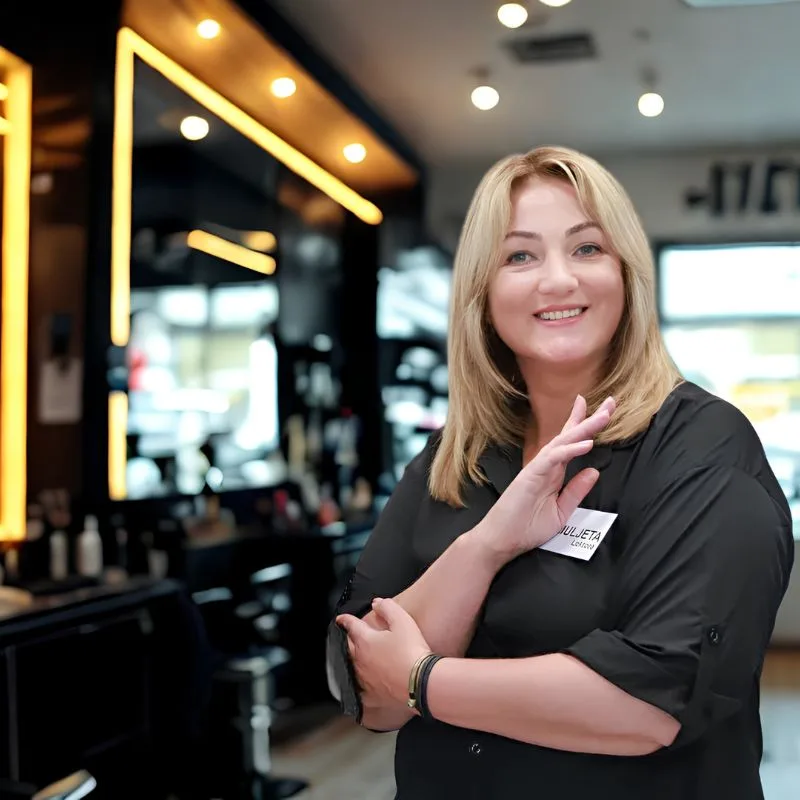
Hairstylist, image designer, lecturer
A creator who sees the beauty industry through a wider lens — over 30 years of experience in salon work, training and professional apparel design.
Read full bio →How professional dye differs from drugstore "box" dye — color control, oxidant choice, grey coverage and hair condition.
Read more →ProductsA larger package is not just more product. We compared prices, usage efficiency and practical benefits for everyday salon work.
Read more →The numbers speak for themselves. Try Color SHOCK 180 ml dyes and feel the difference in your work — from the very first application.
View products →News, promotions and tips for professionals — straight to your inbox.