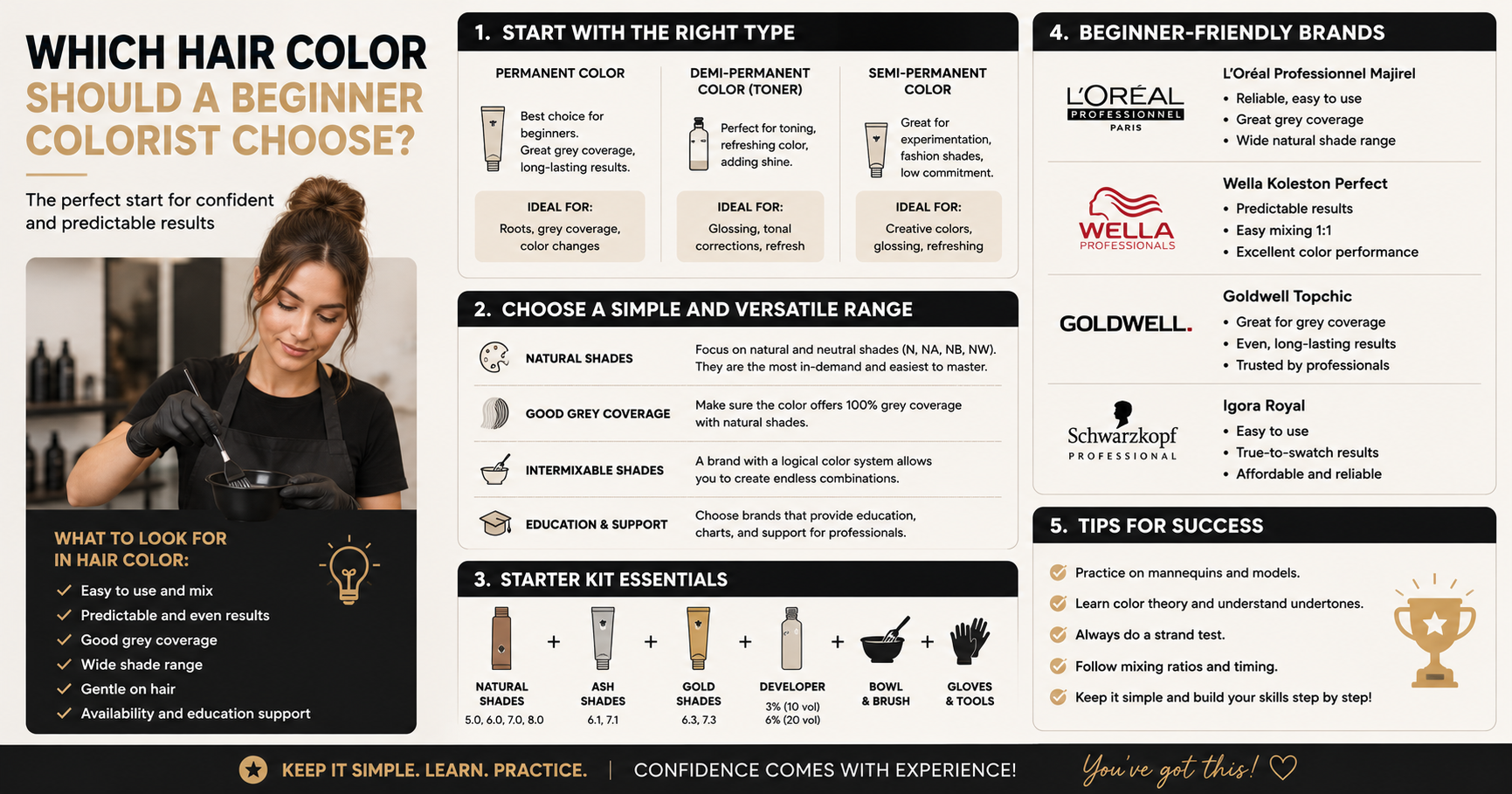
A beginner colorist should start with a base palette of natural tones (.0), a few ash (.1) shades to neutralise warmth, and a developer set (10, 20 and 30 vol). Color SHOCK 180 ml tubes (from €7.90, €0.044/ml) make practice cheaper — a lower cost per application means learning mistakes cost less. This article covers the specific starter palette, the essential tools, the first jobs to take on and the mistakes worth avoiding from day one.
You will find all 50+ shades with numbers and descriptions in the colour palette — expand your palette based on real client demand, not 'just in case'.
Numbering is the colorist's alphabet and works the same way across professional palettes. The digit before the dot shows the depth level from 1 (black) to 10 (very light blonde); the digits after the dot show the tone direction: .0 natural, .1 ash, .3 golden, .8 chocolate. For example, 8.1 is a light blonde in the ash direction. The same logic helps when choosing the developer: the bigger the gap between the current and the target depth level, the stronger the concentration needed. Once you have learned the numbering, any shade can be 'read' before the tube is even opened, and mixing becomes predictable.
Three are enough: 10 vol (3%) for tone-on-tone and grey coverage, 20 vol (6%) for universal 1–2 level lift, 30 vol (9%) for stronger lift. The mixing ratio with colour is 1:2. Later, 1.5% (5 vol) will come in handy for toning after lightening. For exact mixing and quantities, see the article on mixing colour with developer.
The most predictable jobs for a beginner are tone-on-tone, darkening and grey coverage with natural tones: they have the fewest variables and the most repeatable results. Leave lightening, colour corrections and techniques like balayage for a later stage — you will find them in the article on colouring techniques.
Before mixing any colour, establish three things. First — the natural base and how much grey it contains. Second — what has been done to the hair before: old colour, lightening or chemical treatments change the result more than the chosen shade does. Third — what the client realistically expects: a photo on a phone says more than a verbal description. Write the answers and the final recipe (shades in grams, developer, timing) on the client card — a month later you will repeat the result exactly, and that is precisely what clients come back for.
Before colouring a client for the first time, always do a strand test — it shows the real result on that specific hair and protects you from surprises with a previously coloured base. A skin sensitivity test is done 48 hours before the procedure — the professional standard.
Mannequin heads with natural hair and models from your circle of acquaintances, booked for simple, predictable jobs, are the right place for first attempts. Record every job: the base, the recipe, the timing, the result and what you would do differently next time — over a few dozen applications such a journal becomes a more valuable teacher than any course. Do not chase speed: it comes with repetition, and fixing a mistake always costs more than an extra ten minutes of work.
A bigger tube at a lower price per millilitre means spending less on practice and trials: Color SHOCK costs €0.044/ml, while a standard 60 ml tube on the market runs at ~€0.183/ml. The colour needed for one average application costs just a few euros — while your hand is still training, that means dozens of cheaper attempts. Check your own numbers in the price calculator.
The starter kit: five natural tones, two ash shades, three developers, scales and non-metallic bowls. With that set you can deliver most everyday salon work at a solid level, and expand the palette based on real demand. The full range is in the product catalogue.
With a base palette of natural tones (.0) from 4.00 to 8.00 and a few ash (.1) shades for neutralising.
Three — 10, 20 and 30 vol. They cover most beginner work; later 1.5% will be useful for toning.
Yes — the professional formula and the 180 ml tube (lower cost per use) let you learn without wasting your budget.
On the colour palette page — all 50+ shades with numbers, tones and links to the products.
Hairstylist, image designer, lecturer
A creator who sees the beauty industry through a wider lens — over 30 years of experience in salon work, training and professional apparel design.
Read full bio →Color SHOCK dye is mixed with developer at a 1:2 ratio. How to choose the developer strength (10/20/30 vol) and avoid mistakes.
Read more →TipsA precise calculation: the dye cost of one coloring with Color SHOCK 180 ml is about €2.63 — roughly 76% less than a standard 60 ml pack.
Read more →The numbers speak for themselves. Try Color SHOCK 180 ml dyes and feel the difference in your work — from the very first application.
View products →News, promotions and tips for professionals — straight to your inbox.